- Profit From Impact
- Posts
- 🍃 Part 1: How impact drives innovation
🍃 Part 1: How impact drives innovation
Why changing the question matters more than changing the solution

Jasper Steinhausen
March 10, 2026
In this short series, I am exploring a simple but often misunderstood idea.
That impact does not weaken businesses.
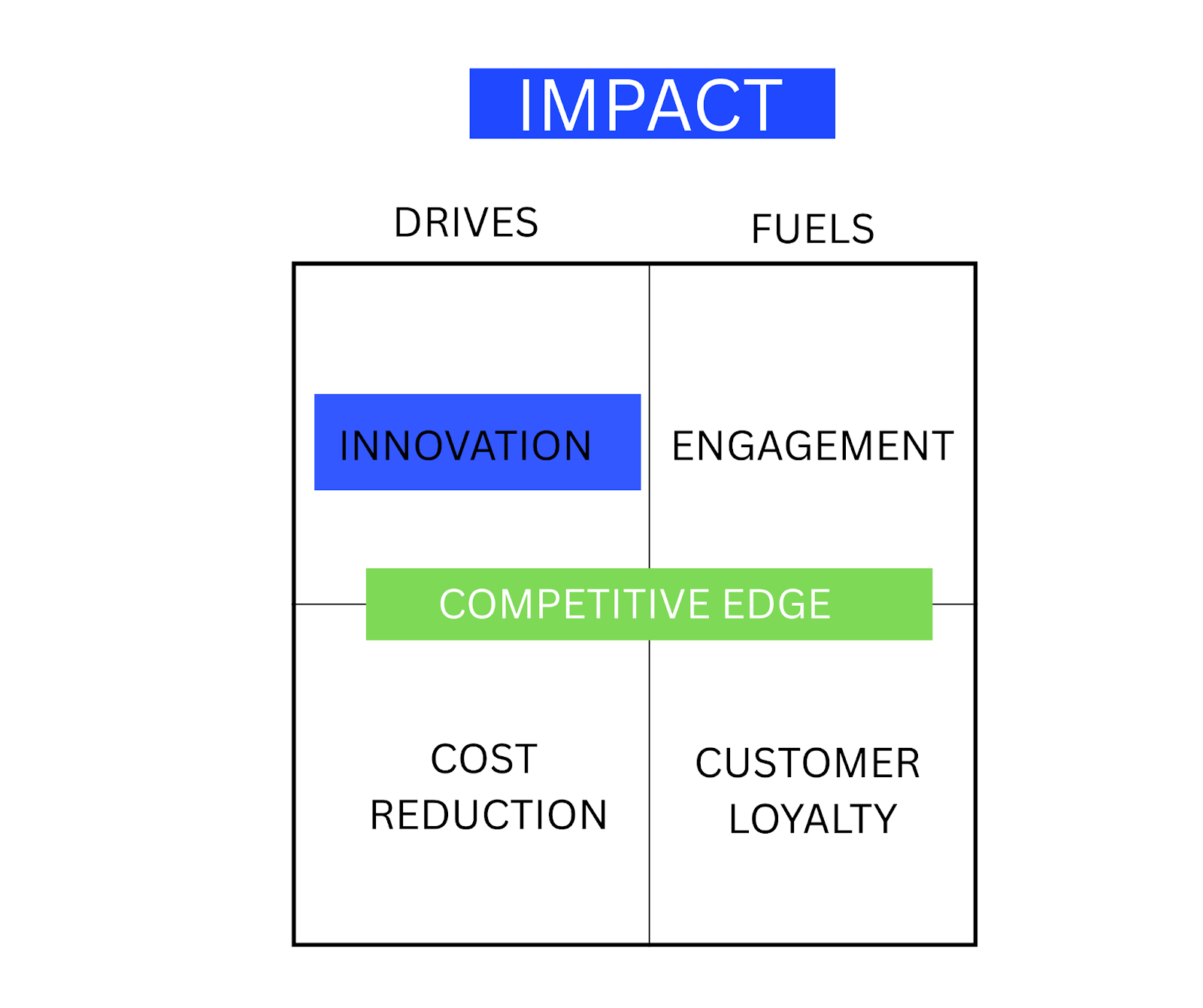
When approached deliberately, impact increasingly drives competitiveness.
Across these newsletters, I am looking at four specific ways this shows up in practice:
Through innovation, cost reduction, engagement, and customer loyalty.
Each email stands on its own, but together they form a clearer picture of how impact moves from intention into advantage.
Today, I want to focus on the first of those areas.
How impact drives innovation.
When people talk about innovation, the conversation usually turns to technology, creativity, or speed.
New tools.
New ideas.
New ways of doing things faster.
What is discussed far less is perspective.
And perspective is often where innovation actually begins.
One of the most consistent patterns I see is this: the moment a business decides that its product or service should have a positive impact, something fundamental shifts in how people think.
Instead of asking, “How do we improve what we already do?”
The question becomes, “What would it take for this to genuinely make a positive difference?”
That single shift forces a new way of seeing.
It pushes teams to look at their product, service, or system from a different angle, which is one of the core principles behind almost every innovation method.
Innovation frameworks rarely start with ideas.
They start by changing the perspective.
An impact lens does exactly that.
It takes existing knowledge and experience and reframes it.
Teams begin to think more holistically.
They pay closer attention to how something is actually used.
They look beyond the point of sale and into the use phase and the post-use phase.
- What happens after the product leaves the factory?
- What happens when it reaches the end of its life?
- What unintended effects does it create along the way?
This kind of thinking is often described as design thinking.
What is interesting is that many of its most valuable elements are automatically embedded the moment impact becomes part of the brief.
But there is another perspective that often appears at the same time.
Leaders begin to look at their biggest business priorities through the flow of resources.
Take something like cost reduction.
Instead of only asking where budgets can be cut, the question becomes:
Where are resources being used?
Where is waste occurring?
And why?
Because resources cost money.
When you look at a business through that lens, new questions start to appear such as is there value hiding in what we currently treat as waste?
And better questions tend to lead to better solutions.
This is why impact so often drives innovation.
In the next newsletter, I will turn to the second area in this series:
How impact drives cost reduction, often in ways leaders do not expect.
👉 For now, a question to sit with:
If you decided that your product or service should have a positive impact while still serving your clients at least as good as today, what new perspectives might appear?
Best,
Jasper