- Profit From Impact
- Posts
- 🍃 Part 3: How impact fuels engagement
🍃 Part 3: How impact fuels engagement
Why meaning has become one of the strongest drivers of performance

Jasper Steinhausen
March 15, 2026
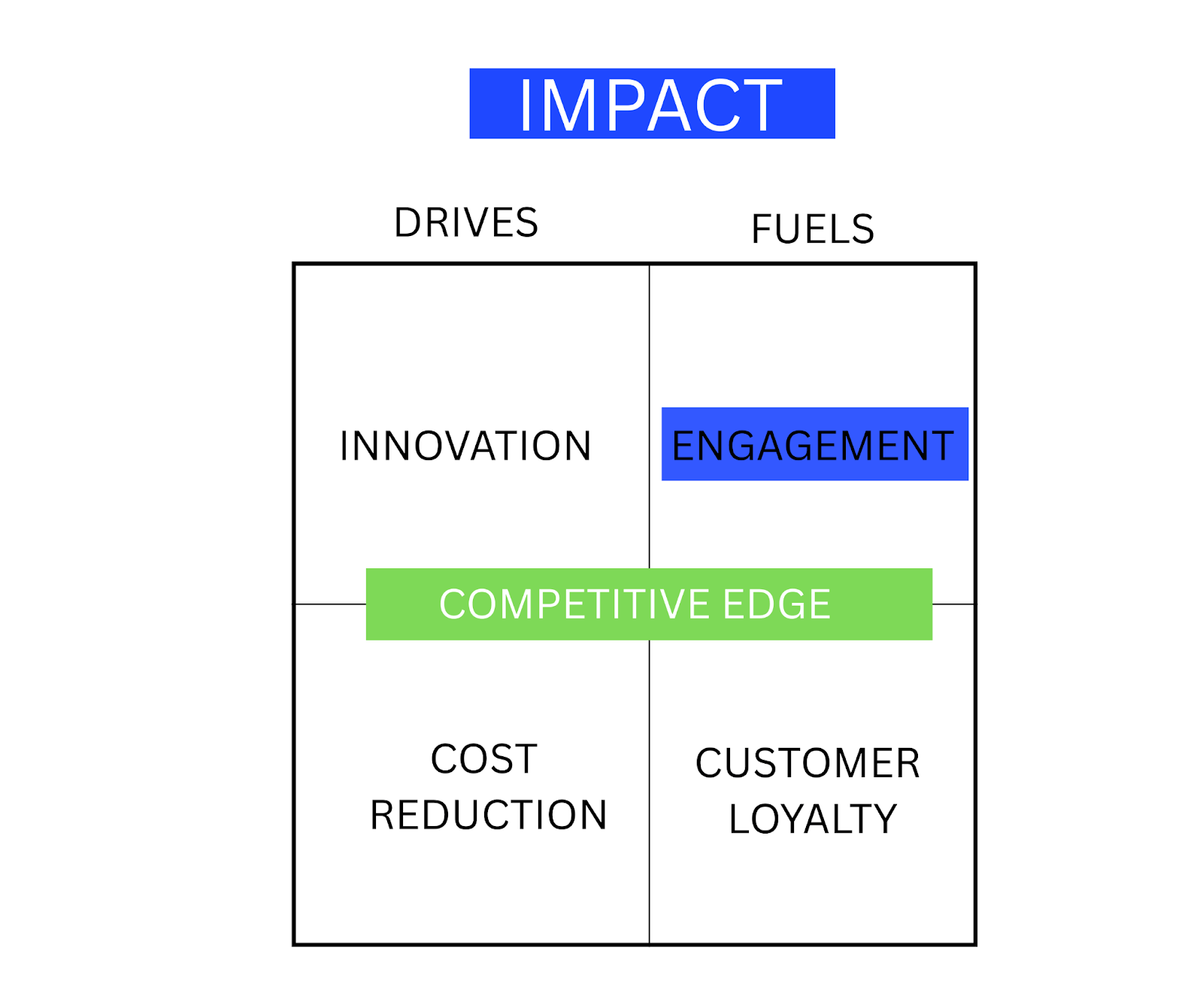
In this series, I am exploring how impact increasingly drives competitiveness.
So far, I have looked at how impact changes perspective and drives innovation, and how it often leads to cost reduction by reshaping how resources flow through a business.
Today, I want to focus on the third area.
How impact fuels engagement.
For most companies, the core offering is not inherently world-changing.
- They make clothes.
- They build components.
- They sell food.
- They provide services.
All of that matters.
All of that solves real problems for customers.
But for the vast majority of organisations, the product itself is not the reason people feel deeply connected to their work.
What changes things is when a company decides that, alongside whatever it already does, it also wants to be part of the solution to a bigger challenge.
That decision adds an additional layer of meaning.
It does not replace the commercial logic of the business.
It sits on top of it.
And that layer matters more today than it did before.
We live in a world where people are constantly reminded that things are moving in the wrong direction.
- Climate change is no longer abstract.
- People read about it in the news.
- They feel it in their own bodies through extreme heat, storms, droughts, or flooding.
Across political views and across countries, the pattern is the same.
Most people want to see more action.
They hope someone will step up.
At the same time, we know something important from psychology.
When people feel anxious, overwhelmed, or pessimistic about the future, the most effective antidote is action.
Being part of something that contributes, even in a small way, changes how people feel.
This is why impact shows up so consistently as a driver of engagement.
When a company chooses to act, and to clearly articulate how it is contributing to something meaningful, people respond.
I have seen this repeatedly over many years, across hundreds of organisations.
Often, increased engagement was not even the intention.
But it shows up again and again.
People feel more proud of where they work.
- They stay longer.
- They are more productive.
- They are more innovative.
- They speak positively about their workplace outside the organisation.
And this effect is not limited to leadership.
It runs from the shop floor to the boardroom.
That is why engagement is not a “soft” outcome of impact.
It is one of the most reliable ones.
In the context of this series, engagement is another way impact translates into competitiveness.
In the next newsletter, I will look at the fourth area: how impact strengthens customer loyalty, and why that link is becoming harder to ignore.
👉 For now, a question to consider:
What additional layer of meaning does your organisation currently offer the people who work there?
If you missed the first or second part of this series, just reply with “Part 1 or Part 2” and I’ll send it your way.
Best,
Jasper