- Profit From Impact
- Posts
- 🍃 Part 4: How impact fuels customer loyalty
🍃 Part 4: How impact fuels customer loyalty
Why better choices, not louder messages, keep customers coming back

Jasper Steinhausen
March 17, 2026
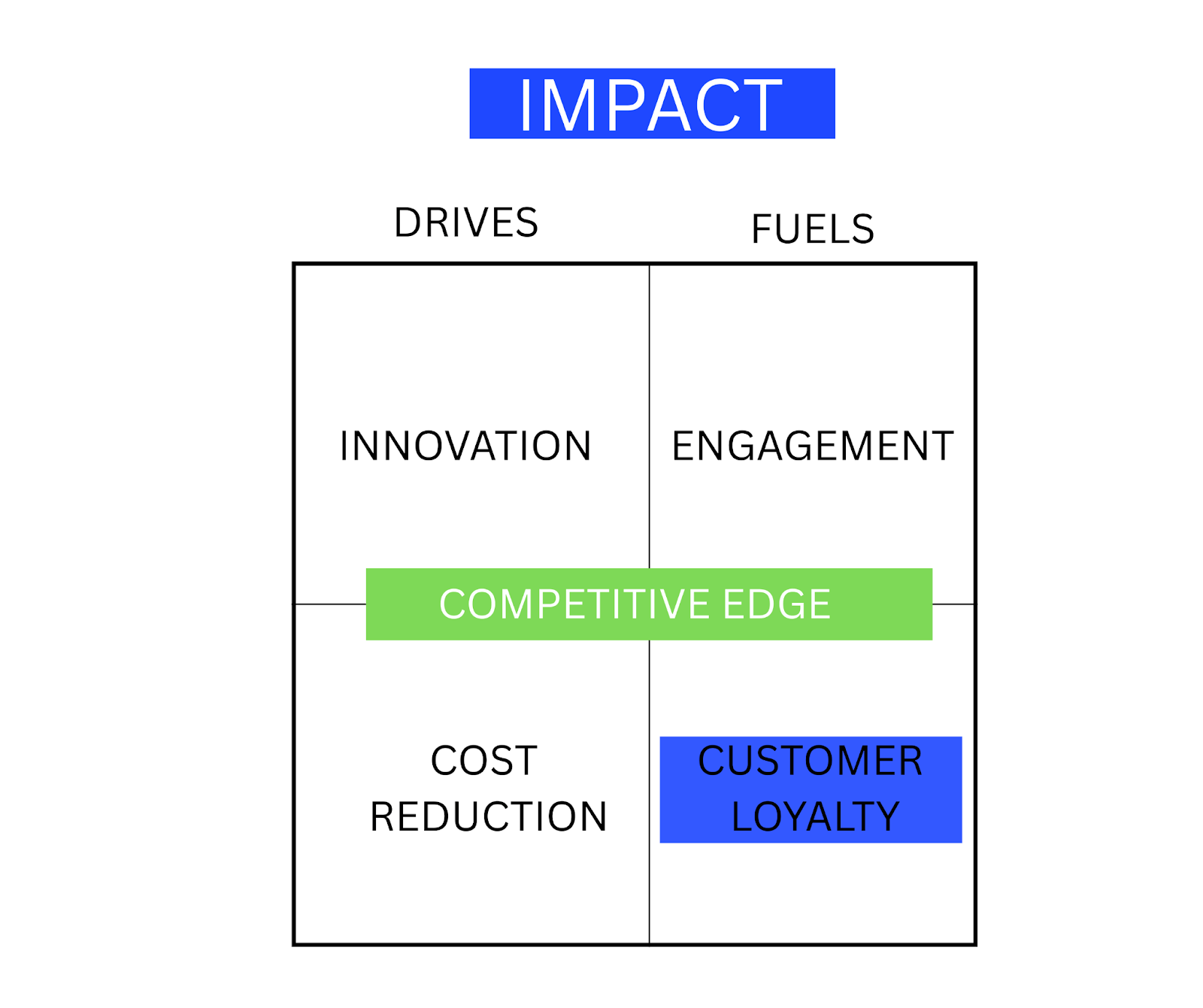
In this series, I have been exploring how impact increasingly drives competitiveness.
So far, I have looked at how impact drives innovation, reduces cost, and strengthens engagement inside organisations.
Today, I want to focus on the final area.
How impact fuels customer loyalty.
This builds directly on the engagement piece, but with an important shift in perspective.
We all consume a lot.
- Products.
- Services.
- Experiences.
And for most people today, there is a growing awareness, sometimes loud, sometimes just humming in the background, that consumption has consequences.
People know that what they buy, use, and throw away has an impact on the world.
That awareness does not mean people want to stop living their lives.
- They still want to travel.
- They still want new shoes.
- They still want good food, comfort, and experiences.
But it does create tension.
Questions start to surface.
- Is this okay?
- Is this necessary?
- Could I be doing this differently?
This is where impact becomes a powerful driver of loyalty.
When a company offers people the opportunity to do the things they already value, but in a way that is better for the planet or society, something shifts.
The product stays desirable.
The experience stays enjoyable.
But the feeling changes.
The quiet sense of guilt in the background is reduced or removed.
And that relief matters more than many businesses realise.
That is the first way impact fuels loyalty.
The second is more structural.
As discussed earlier in this series, impact-driven thinking often leads to innovation.
When companies redesign products and services with impact in mind, they frequently end up creating better versions.
- More thoughtful.
- More durable.
- More aligned with how people actually use them.
So customers are not just choosing a product because it is more sustainable.
They are choosing it because it is simply better.
Put together, this creates two strong reasons for loyalty.
One group of customers stays because the product or service has improved.
Another stays because it has improved and aligns with their values.
And for many, it is both.
This applies in B2C and B2B contexts alike.
- A more holistic view.
- Greater attention to the use phase and post-use phase.
- A stronger customer-centric focus.
All of these tend to produce solutions that people want to return to.
That is why impact driven loyalty is rarely about marketing.
It is about design.
In the context of this series, customer loyalty completes the picture of how impact translates into competitiveness.
Not through trade offs, but through better outcomes.
👉 A final question to reflect on:
What would change for your customers if choosing your product felt like a better decision in every sense?
If you missed the first or second part of this series, just reply with “Part 1, Part 2 or Part 3” and I’ll send it your way.
Best,
Jasper